Menu economics
Which dishes carry the margin?
EHS examines: recipe cost, yield, price and item mix on a stated GST basis. Contribution is not net profit.

Restaurant & café performance consulting
Elite Hospitality Solutions (EHS) works with restaurant and café owners to bring menu economics, labour and service capacity, guest experience and management routines into one practical operating picture. Start with the question behind the numbers: where is the venue making money, where is performance being lost, and what should management change first?

The operator’s view
Full tables and a hardworking team do not automatically mean healthy margins or a sustainable service model. EHS starts with the operating question behind the number, then examines the connections that could explain it.
Which dishes carry the margin?
EHS examines: recipe cost, yield, price and item mix on a stated GST basis. Contribution is not net profit.
Does the roster follow demand?
EHS examines: demand by service period, paid hours and role coverage. Not award or payroll advice.
Where does service consistency break down?
EHS examines: agreed criteria, visit evidence and how service problems are recovered.
Do reports lead to action?
EHS examines: routines, escalation points and follow-through on agreed actions.
A clear starting point
A focused remote Snapshot can help identify what the available information supports. A deeper Diagnostic suits a question that needs reconciled data, management context or agreed observation. They are distinct services, not one report in two sizes.
Remote entry review
For an owner or general manager seeking an initial view of one venue over an agreed recent period.
Remote document review only. No on-site observation, financial audit, legal assurance or guaranteed savings.
Explore the SnapshotDeeper, agreed-scope review
For a decision that needs detailed information and operating context brought together.
A visit, observation, implementation or ongoing review is included only when separately agreed.
Explore the Full DiagnosticFees, timing, responsibilities, exclusions and information requirements are confirmed in a written scope before any engagement is accepted.
The EHS Performance Loop
A working framework that connects a defined question with evidence, feasible options and a later review where follow-up is agreed.
01
Agree the question.
02
Establish evidence.
03
Compare options.
04
Put actions to work.
05
Review what changed.
Follow-up informs the next decision
Fictional report demonstration
The four-page example uses synthetic restaurant figures to show how a useful diagnostic can state definitions, assumptions, limitations, a potential next action and a follow-up measure.
Illustrative format · synthetic dataArithmetic only: $42,000 ÷ 2,100. These totals do not show whether staffing matches demand. No labour change or savings recommendation is made.
The example is not a real venue analysis, an achieved outcome or a benchmark.
See the sample reportSpecialist support
Start with one decision. Extend the scope only where evidence and agreed delivery capacity support it.
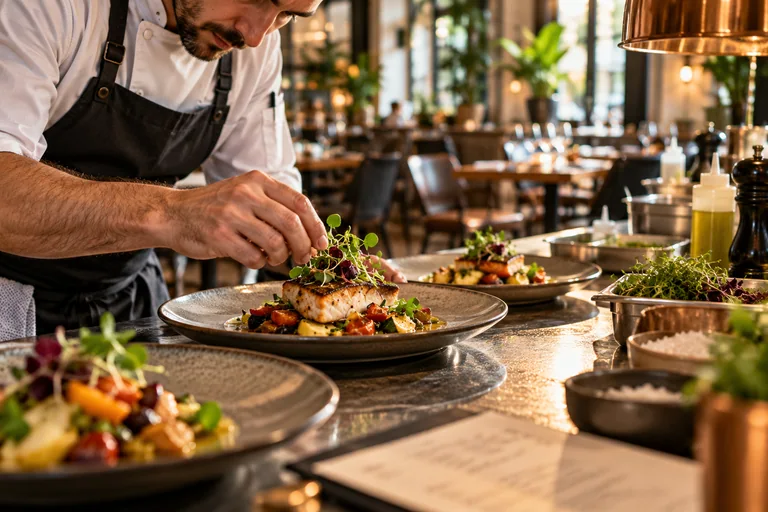
01 · Menu economics
Understand recipe cost, yield, price and item mix alongside kitchen practicality.
Explore menu service →
02 · Service capacity
Compare matched service demand, paid hours, skills and role coverage.
Explore labour service →
03 · Guest journey
Turn agreed, observable service feedback into constructive action.
Explore guest experience →
04 · Management routines
Clarify checks, handovers, escalation and follow-through across shifts.
Explore management systems →These descriptions outline proposed services, not confirmed current availability or delivery history.
The principal
Kris Ford brings an extensive hospitality-industry background, alongside business and strategic-management study. His EHS point of view connects the pressures of live service with menu and operating economics, labour capacity, guest experience and management accountability.
Clear evidence, practical decisions and a named next step matter more than easy promises.
Common questions
No. A fit discussion can establish what information is available. If records cannot support a reliable analysis, that limitation should be explained before work is scoped.
No. A diagnostic can clarify evidence, constraints and options. Any scenario estimate is labelled with assumptions; it is not an achieved or guaranteed result.
A Snapshot is remote. A visit or service observation is included in a deeper engagement only when separately agreed, authorised and available.
The question, information quality and agreed activities shape the written scope. Deliverables, exclusions, fees and timing are confirmed before any engagement begins.
A good place to begin
Describe the venue and the question you are weighing. The enquiry page explains what information to include. Please do not send confidential financial, employee or guest records.